 Queberry
Imagine that you are in a store, have all you need in your cart, and want to check out. However, here comes the problem — there is not much happening in the queue. The cashier struggles with calculating the price. The card machine doesn't work. Someone is having an issue with a voucher at the counter.
The bright side of this story is that all this irritation can be dealt with. Let's find out what we are talking about and how retailers can solve their problems.
What You'll Learn in This Guide
What Is Checkout Friction?
Checkout friction does more than just making the customer's experience unpleasant. It may impact sales negatively.
Imagine you're browsing online. You've put some items into the cart, proceeded to checkout only to realize that there are additional steps or charges. You decide to abandon the purchase. This is what commonly happens during online purchases; however, the same situation may occur offline.
A person waiting in a long queue will probably walk away if they have no time for it. Even if they buy something, the bad checkout process can influence their future decisions regarding that store.
An efficient checkout process leaves customers satisfied and makes them perceive brands positively. The inefficient checkout process makes clients go to other stores. Having plenty of choices at hand, clients won't hesitate much before moving to competitors.
Why This Actually Costs Retailers Real Money
The thing that every retailer needs to pay special attention to is the impact that checkout friction can make on abandoning sales. It is likely that you have already made an experience when, during your online purchase, you have added some products to a cart but have stopped buying after finding out that there are additional steps to go through. The same happens offline: a person may decide not to buy something because there is a long queue at checkout.
Moreover, checkout problems may damage customer loyalty. As you already know, when someone experiences satisfaction while using some service or product, he/she will become a regular customer who will keep using the same one. However, if the purchasing process causes troubles, people will be able to recall it the next time when choosing the retailer. Nowadays, there are a lot of alternatives available to customers, and, hence, any inconvenience may result in lost sales.
The Key Factors Contributing to Checkout Friction
Before fixing anything, it helps to know what's actually causing the slowdown. Most checkout problems fall into a few buckets.
How Retailers Can Actually Fix It
Now for the part that matters most: real, practical ways to smooth out checkout and keep customers happy.
Upgrade to faster, smarter checkout technology
The latest point-of-sale systems and terminals can carry out processes much more quickly than outdated ones. With faster equipment, there will be less downtime and less "try that again."
Offer multiple checkout options
Everyone doesn't have the same preferences. Some like to scan their own items at the supermarket, while some may prefer assistance from someone else. Providing customers with the option to choose either type of checkout will make them more comfortable.
Use data to predict busy times
Smart scheduling based on past sales patterns helps make sure there are enough staffed registers open exactly when the store gets crowded, instead of guessing and hoping it works out.
Simplify the steps
For online stores, this might mean allowing guest checkout instead of forcing an account signup. For physical stores, it could mean training staff to handle returns, coupons, or price checks faster, or removing unnecessary verification steps altogether.
Make self-checkout actually smart
Better sensors, clearer instructions on the screen, and AI-powered systems that catch errors instead of creating false alarms can make self-checkout genuinely faster instead of just a hands-off version of the same friction.
Replace multiple confusing lines with one smooth one
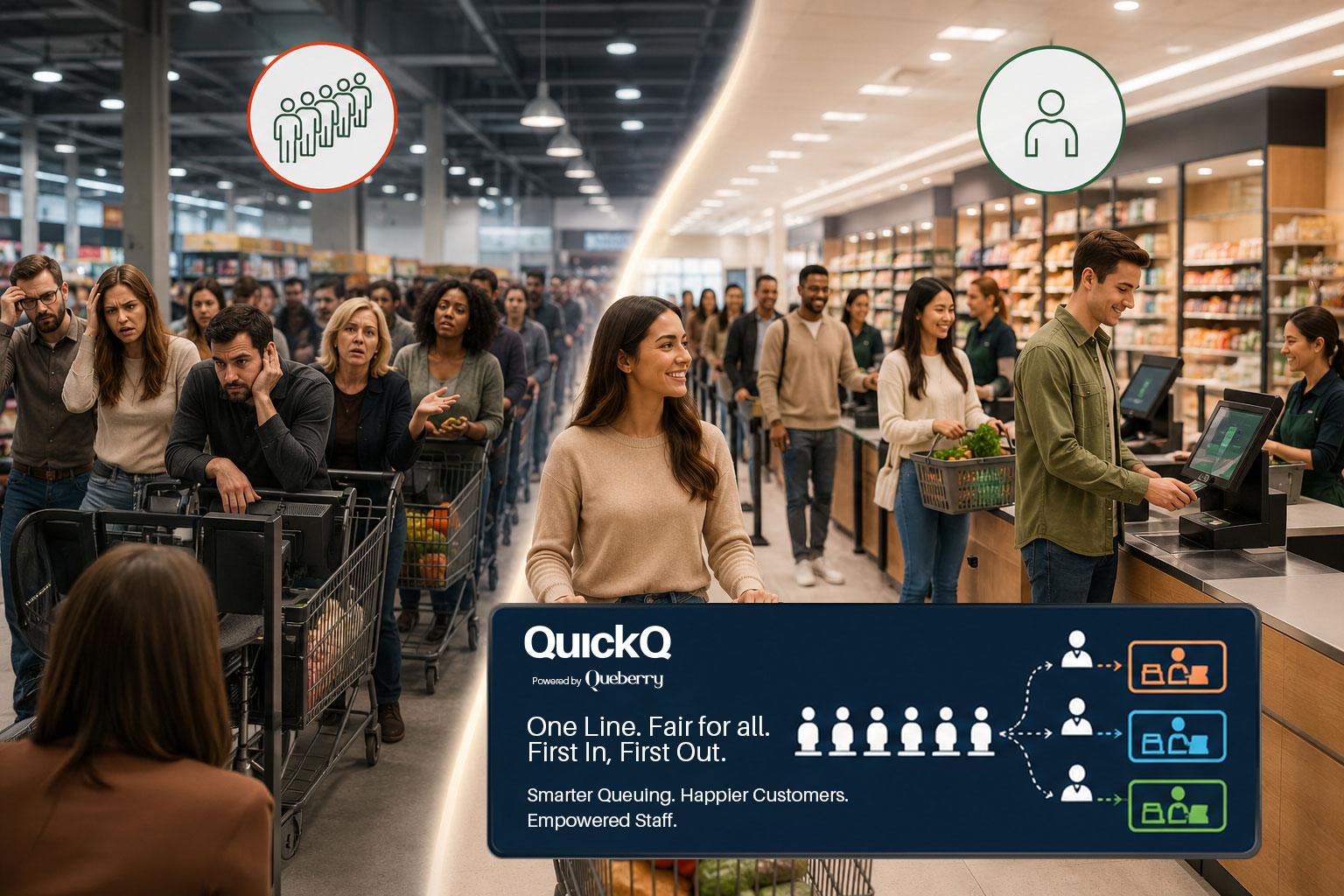
Rather than customers choosing a line randomly and then hoping for the best, QuickQ queues all of them in a single line. Color coding ensures customers are directed to the appropriate counters without having to worry about whether they should stand in Line A or B based on its pace. There's no need to make such a decision because there is just one line. The software operates on a First In First Out principle and hence all customers are attended in the sequence of their arrival.
QuickQ relieves employees from the need to deal with the crowd and helps them concentrate on their primary goal — assisting clients. By directing customers to the corresponding lines and counters, the system relieves workers of extra tasks and saves their energy for dealing with more complex and interesting situations. This leads to improved satisfaction among customers as they do not have to waste time and struggle to find their ways around the store.
Integrate systems so everything talks to each other
Once there is an integration between inventory, customer loyalty programs, and payment systems, the entire process becomes seamless. There are no discrepancies about pricing or issues with coupons not working.
Keep staff trained and ready
Technology is not everything; there also must be employees skilled enough to operate it efficiently and calmly resolve any problems that may arise. Such an employee will easily manage to make a problematic checkout procedure go smoothly.
Ultimately, the checkout process is where a consumer ends his shopping experience — it is what he remembers last from the shopping trip, and what is remembered last leaves an enduring impression on the consumer. A convenient checkout system does not only save the consumer time but earns him as well. It conveys to him the idea that the retailer recognizes how valuable his time is and wishes to have him return in the future. The retailers who will realize that a poor checkout experience for consumers is an issue that must be addressed are those who will retain their consumers rather than lose them to other retailers in the neighborhood.
