 Queberry
Let's be real. Nobody likes waiting in a queue. Not at the bank. Not at a hospital. Not at a government office. Not anywhere.
But here's the thing — most businesses have accepted long queues as an unavoidable part of operations. What they haven't accepted, and what the smart ones are actively fixing, is the experience of waiting. And that's exactly where digital signage steps in.
What You'll Learn in This Guide
- Chapter 1: The Waiting Problem Is Mostly a Mind Problem
- Chapter 2: What Does "Digital Signage in Queue Management" Actually Mean?
- Chapter 3: Three Things Digital Screens Do That Static Signs Simply Can't
- Chapter 4: Getting It Right — What Good Deployment Actually Looks Like
- Chapter 5: Is It Worth the Investment?
The Waiting Problem Is Mostly a Mind Problem
Before diving into screens and software, it helps to understand something counterintuitive: the length of a queue matters far less than how informed the person standing in it feels.
Research backs this up. People who are given no information about how long they'll wait routinely overestimate their wait by over a third. That means a 10-minute wait feels like 14 minutes. A 20-minute wait feels like 28. The actual time hasn't changed — the perception of it has, simply because nobody told them what was going on.
This is the core problem that digital signage in queue management solves. Not by making queues shorter (though it can help with that too), but by making the wait feel shorter — which, from a customer experience standpoint, often matters more.
What Does "Digital Signage in Queue Management" Actually Mean?
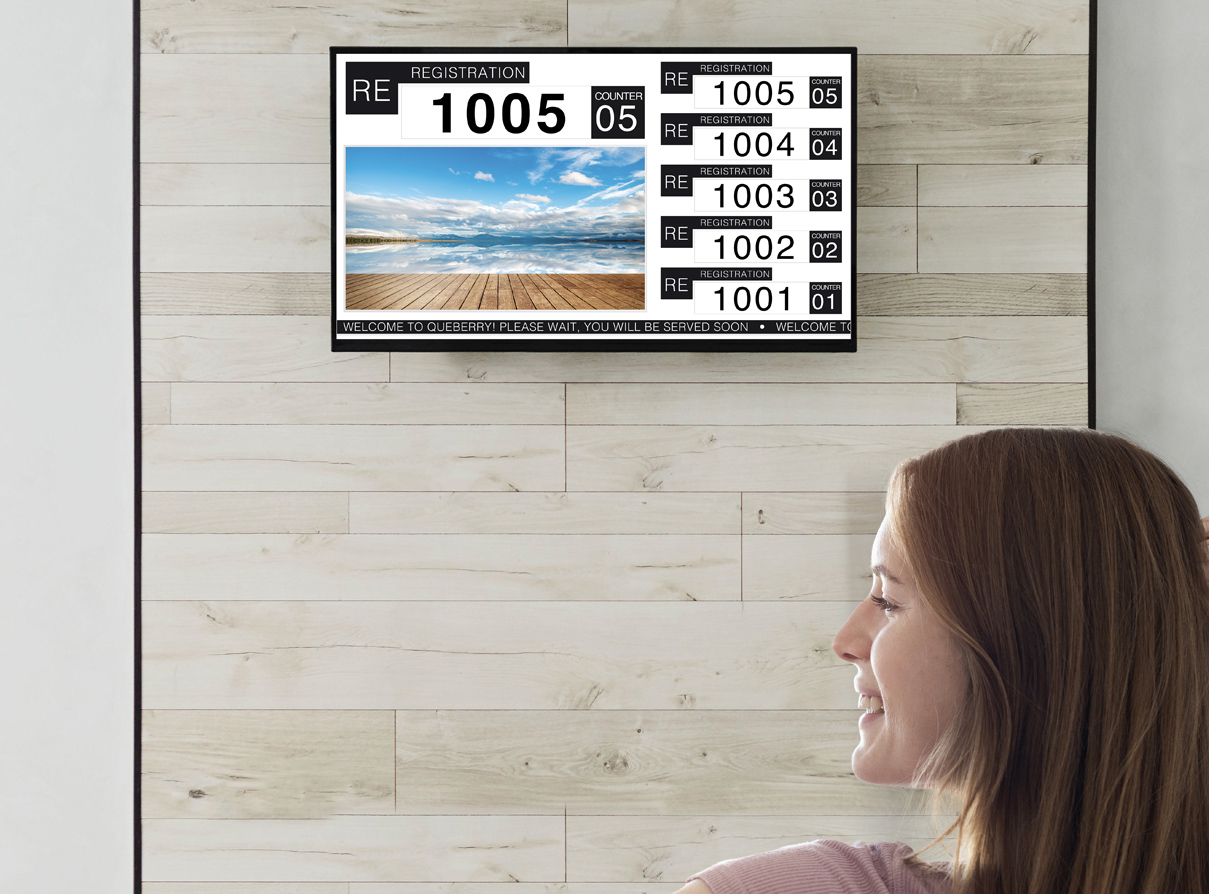
At its most basic level, it is a display screen linked up to a queuing management software which allows customers to know their position in the queue, estimated waiting time, and happenings around.
At its most advanced level, it is an array of screens located at entrance points, halfway through the queue, and at service points, with each screen having its own unique function. Imagine a television screen hanging on a wall and compare that with a sophisticated communication system that operates in the background.
Industries such as banking, healthcare, retail, aviation, government departments, and hospitality, amongst others, have embraced this concept wholeheartedly due to its effectiveness.
Three Things Digital Screens Do That Static Signs Simply Can't
They show live queue data.
A printed sign can tell you where to stand. A digital screen connected to a platform like Qmatic, Wavetec, or QLess can tell you "Now serving number 39 — you're number 47, estimated wait: 9 minutes." That single piece of information changes the entire emotional state of the person waiting.
They occupy attention in a useful way.
Cognitive psychology has long established that occupied time feels shorter than unoccupied time. When a screen is showing you something relevant — a how-to guide, service information, local news, or even just a clear countdown — your brain stops obsessing over the clock. Content management systems like ScreenCloud, Yodeck, and Xibo make it straightforward to schedule and rotate content based on time of day, audience type, or even how busy the queue currently is.
They distribute the load.
Self-service check-in kiosks with integrated digital displays let customers register themselves, receive a queue number, and get directed to the right area — all without needing to interact with a staff member first. This takes pressure off front counters and smooths out the peaks that cause queues to pile up in the first place.
Getting It Right: What Good Deployment Actually Looks Like
A screen in the wrong place does very little. Placement matters enormously.
Content Priority
Content priority is another thing businesses get wrong. Entertainment is great, but it should never crowd out queue information. The wait time and queue number need to be the most visible thing on the screen at all times. Everything else is secondary.
Accessibility
Accessibility also deserves more attention than it usually gets. Screens need adequate contrast ratios, readable font sizes at real-world viewing distances, and audio integration for customers with visual impairments. These aren't optional extras — they're part of building a system that actually works for everyone.
Is It Worth the Investment?
For most businesses that operate with physical queues, the honest answer is yes — often significantly so.
Reduced walkaway rates protect revenue directly. Branded content shown during wait time creates upsell exposure that didn't exist before. Staff freed from manually managing queues can focus on actually serving customers well. And the brand perception lift that comes from running a visibly organised, well-communicated waiting environment is harder to quantify but very real.
Queue management technology is also moving fast. AI-driven wait time prediction, mobile virtual queuing, and full omnichannel journey integration are already in use at scale in some sectors. The display screen — the thing the customer actually sees — remains the point where all of that back-end sophistication finally meets the human experience.
Getting that layer right is worth the effort.
