 Queberry
If you’ve spent any time managing airport terminal operations, you know the exact sound of a brewing logistical headache. It’s the restless shuffle of hundreds of passengers trapped in a stagnant snake of a queue, clutching crinkled paper tickets, and looking back and forth between their slips and a flashing overhead screen.
For years, the industry baseline for managing passenger flow was simple: give them a ticket, give them a number, and tell them to wait. But at a certain volume, traditional queue management doesn't solve chaos—it just organizes it.
When you are tasked with keeping passengers moving smoothly across dozens of active counters, relying on a system built around physical tokens creates a massive blind spot. That is exactly why forward-thinking hubs are moving away from the "take-a-number" status quo and pivoting toward intelligent, ticketless directional environments.
Here is a look inside why eliminating physical tokens completely transforms terminal efficiency, and how a modern framework like the QuickQ Smart Ticketless Passenger Guidance System rewrites the operational playbook.
What You'll Learn in This Guide
- Chapter 1: The Hidden Friction of Physical Queue Tickets
- Chapter 2: Inside a Ticketless Flow — The 5-Step Continuous Stream
- Chapter 3: From the Terminal Floor to the Control Room — Live Analytics
- Chapter 4: Key Operational Metrics At a Glance
- Chapter 5: Setting Up for Scale — The Centralized Architecture
- Chapter 6: Moving Beyond Common Knowledge
The Hidden Friction of Physical Queue Tickets
On paper, a ticketed queue system seems fair. In reality, it introduces subtle, compounding delays that drag down airport performance:
Inside a Ticketless Flow: The 5-Step Continuous Stream
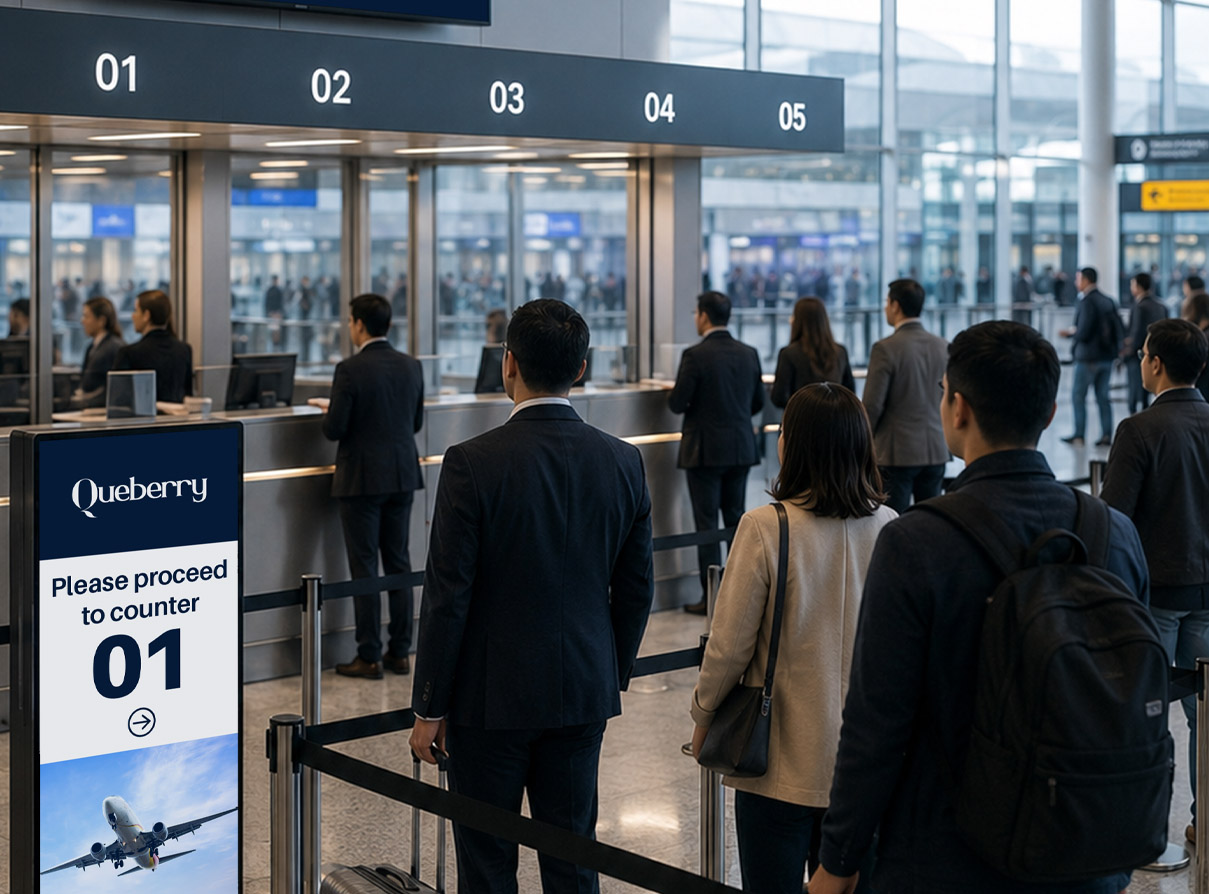
A smart, ticketless guidance system replaces static waiting with active, natural movement. Instead of keeping passengers staring down at a piece of paper, the environment itself guides them smoothly.
The setup transforms the check-in or service zone into a high-speed line through five simple phases:
Queue
Becomes Available
Display Update
Proceeds
Completed
By removing the extra step of checking a physical token, passenger transit becomes an active, natural flow. Passengers keep their eyes up, their bags ready, and their movement intentional.
From the Terminal Floor to the Control Room: Using Live Analytics
You cannot improve what you do not measure. The true power of switching to a digital, ticketless framework isn't just a cleaner terminal floor — it is the wealth of real-time data unlocked for airport operations managers.
When deploying an ecosystem like QuickQ, terminal leadership gains access to a centralized dashboard tracking the exact numbers that make or break daily service targets:
Key Operational Metrics At a Glance
| Key Operational Metric | Operational Benefit |
|---|---|
| Total Passengers Served | Tracks real-time volume milestones across airport zones. |
| Active Counter Ratio | Provides instant visibility into exactly how many desks are online (e.g., 32 out of 48 counters). |
| Queue Length Over Time | Pinpoints exact operational hours where passenger flow experiences friction. |
| Counter Efficiency Reports | Details staff productivity and how fast specific counters are handling passengers. |
Setting Up for Scale: The Centralized Architecture
An enterprise-grade guidance system must be sturdy yet simple. From a technical standpoint, a ticketless passenger guidance architecture minimizes on-site hardware issues by using a streamlined, connected model:
Moving Beyond Common Knowledge
The common assumption in crowd management is that more signs or longer counter desks solve airport congestion. But true operational excellence comes from eliminating hidden friction points.
Dropping physical tokens, centralizing display management, and watching live data is the ultimate way to turn a chaotic waiting room into a high-efficiency passenger pipeline.
